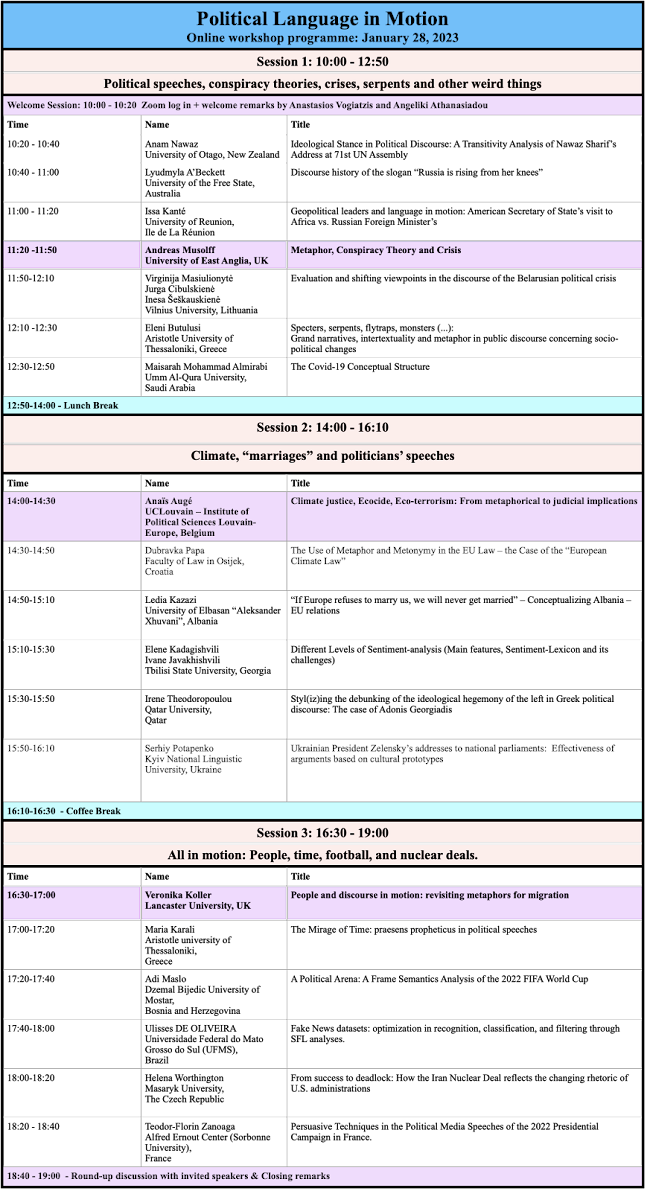
Dr. Andreas Musolff University of East Anglia, UK A.Musolff@uea.ac.uk Metaphor, Conspiracy Theory and Crisis Metaphors have been known at least since Aristotle to be extremely useful in social and political crises for one purpose ( inter alia ): to highlight, exacerbate, exaggerate or, in modern parlance, ‘weaponize’ the crisis in question. Strictly speaking, metaphors do not achieve this feat on their own: they are aided and abetted by hyperbole, metonymy, analogy and, if needed, by the whole gang of rhetorical tricks known since Antiquity as figures or tropes. Conceptual Metaphor Theory (CMT) has tried to exonerate metaphors from the association with demagoguery; however, in the form of Critical Metaphor Analysis (CMA), metaphor’s power of shaping social and political processes in detrimental ways has become a central research object across several domains of study, e.g. Psychology, Media Studies and Discourse Studies. Taking one of the many recently erupted crises, i.e. the Co...
Online workshop - Call for papers Political Language in Motion Saturday 28 January, 2023 Workshop organizer: Dr. A. Vogiatzis Aristotle University of Thessaloniki, School of English Email: polmo365@gmail.com , www.enl.auth.gr/tclr With the world experiencing events and changes of historical proportions, such as the pandemic, the attack of Russia on Ukraine, the climate crisis, the transition from fossil fuels to renewable sources of energy, political leaders, policy makers, and stakeholders have had to introduce, promote, - or even deny - changes and events that alter the status quo and affect the public directly or indirectly. In physical space, motion entails constant change and evolution; when political language is in motion it is used dynamically in order to accommodate and account for policy change. Political Language in Motion aims to actively address the issue of the way politicians, policy makers, and stakeholders make use of conceptual tools and draw from cen...
Σχόλια
Δημοσίευση σχολίου